|
Down on the Farm November/December 2008 Winds of Change Mortenson leads an industry push for building more wind-energy infrastructure across the country By Bruce Buckley
A year and a half out of school, Parker Lohrenz has the wind at his back. The Iowa State graduate, now a field engineer with Minneapolis-based Mortenson Construction, is hustling along in the fast-paced, high-intensity world of wind farm construction. He’s already helped sew up multimillion-dollar projects from the farmlands of Illinois to the rolling hills of Montana, logging long hours on expansive sites in the face of arduous schedules and often-volatile conditions. "When you flip that switch and see a turbine start spinning, you know you’ve accomplished something special," Lohrenz says. "It’s a difference that you can see in action, from flat grass to a tower that’s generating clean power. It’s a great feeling." After a decade in the wind-energy business, Mortenson is now one of the top builders of wind farms in the country. At the start of 2008, the company’s burgeoning Energy Group had completed 50 wind projects in the U.S., representing one-third of the country’s wind-generating capacity.
By early 2009, it will complete its 75th wind farm project. Mortenson crews have traveled to 17 states, delivering projects from the Midwest to west Texas, Oregon and West Virginia. Today, wind energy-projects represent 20% of Mortenson’s $2.2 billion in annual revenue. New Energy Pride It’s been an unlikely success for Mortenson. When the company was approached 10 years ago by a client looking to build a wind farm in Minnesota, Jerry Grundtner, vice president of project development at Mortenson Energy Group, decided to lead the company down an uncertain path. "It was pretty lonely back then when it was only me," Grundtner says. "No one could have envisioned what it would develop into. It was a boutique business back then. In the last four years, it has been recognized as mainstream utility-scale power generation. Utilities want these projects in their portfolios of assets." While Mortenson has reaped the rewards for those decisions, the crews in the field are proud to be part of something bigger than balance sheets. "There isn’t a person out here in the field who isn’t proud to be contributing to clean power," says Kurt Arentsen, senior project manager at Mortenson. "Our guys are proud to put turbine stickers on their pickups or hats to show everyone they put up wind towers. It’s something more than putting up a stadium or laying a stretch of road. It means a lot to these guys."
That collective passion has proved to be a valuable asset in the demanding wind-energy sector, where owners push for projects to wrap up in a matter of months. Lohrenz was on the crew that brought the $200-million Camp Grove Wind Farm in western Illinois’ Stark and Marshall counties online in January for developer Orion Energy Systems, Manitowoc, Wis. In eight months, more than 200 workers erected 100 GE Wind Energy 1.5-MW turbines on 80-meter steel towers across a 50-sq-mile site. A single 1.5-MW turbine can power about 400 homes for a year. Moving people and equipment across the site required the construction of approximately 25 miles of access roads. Crews installed 61 miles of a 34.5-kV underground electrical collection system, 9 miles of 138-kV overhead transmission lines, an interconnect switchyard and a step station. Three meteorological towers and an operations and maintenance facility also were built. "The speed of these projects is something you have to live to believe," Lohrenz says.To keep pace, repetition is a welcome but often elusive goal on wind-farm jobs, Arentsen says. Crews aim to create a massive assembly line spread across miles of terrain. As a specifically tasked crew completes its work on a tower, it moves down the line to the next tower site, with other crews moving along behind it.
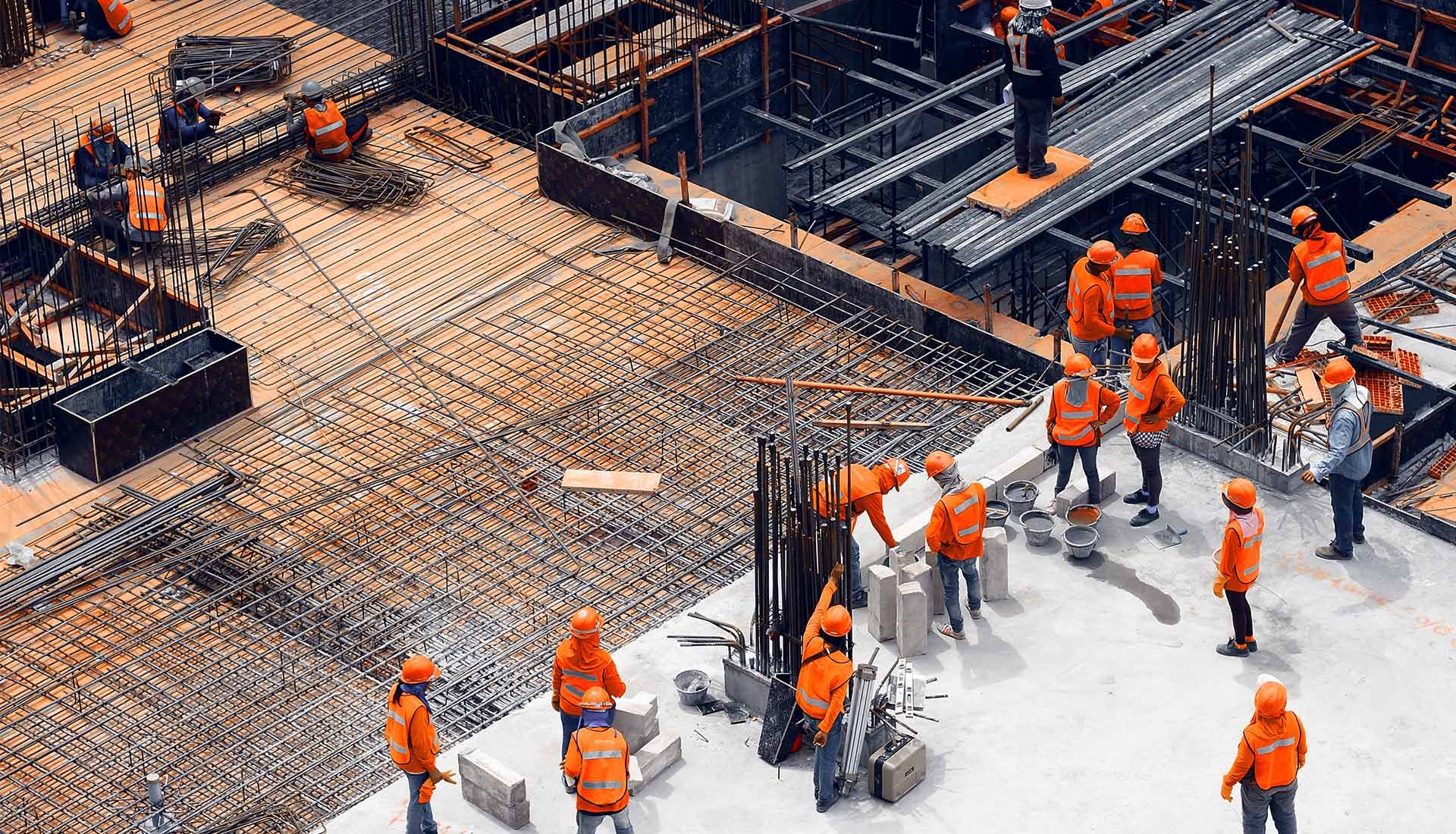
"It’s all about getting into a rhythm," Arentsen adds. "Whether it’s trying to complete two foundations and two towers per day or three and three, you want to get that pace going. It’s a significant milestone on any project when you find your rhythm." Assembly Line The basic construction tasks are similar from job to job. After creating access roads and grading a tower site, crews typically build a spread-footing foundation. Ranging from 50 ft to 60 ft across and 7 ft to 8 ft deep, foundations require anywhere from 350 cu yd to 600 cu yd of concrete and 20 to 40 tons of rebar. Electrical conduits are embedded in the foundation. They will eventually connect the tower to the underground collection system. A pedestal that sits atop the foundation attaches to the first base section of tower with anchor bolts. Additional sections of tower are then attached to each other by bolted flanges. The tower is topped with a nacelle, which houses most of the electronics and the generator. Finally, the rotors, which are preassembled on the ground, are lifted and attached to the nacelle. Once a tower is erected, electricians move in to connect the wiring. Turbine suppliers then send in their commissioners to test the tower before it goes live. Multiple cranes are deployed, ranging from 65-ton RTs, which off-load parts and set rebar to the main erection cranes that can range from 300 tons to 600 tons. The number of cranes used depends on the speed of the project. Typically, an erection crane can build one tower per day, Arentsen says. Staying on schedule requires months of preplanning. By design, projects are located in high-wind areas, a necessity for energy companies that demand a reliable power source but a challenge for construction crews. Many large erection cranes cannot make lifts in winds blowing above 20 mph. Historical mapping of wind patterns determines the windiest seasons of the year as well as the windiest times of day. Construction must stop if a site gets too windy.
"You get guys who end up working 14-hour days and then they might not work for several days," Arentsen says. "You can’t just send them home, because if they don’t get a full 60 hours, they go elsewhere. So we might just pay them to sit around. Then they have to work more long days to make up lost time. It’s tough to keep people motivated and on-task in that environment."
The remoteness of most jobsites doesn’t help either. Many of the 325 workers on Mortenson’s Cedar Creek Wind Farm project in Colorado were forced to commute two hours from Denver, with some living in Wyoming and Nebraska. "You can’t build near a town of 50 people and expect to find rooms for 300 guys," Arentsen says. "These guys work long days and then might have to drive 80 miles to live in what might not be the best of conditions." That’s when dedication pays off, Lohrenz says. Whether it was on the jobsite or after-hours, Lohrenz saw team members bond on the Camp Grove project. From eating homemade jerk chicken with Jamaican-born senior project manager Dowen Virgo to hitting the nightclubs in the nearest city, the team stuck together from start to finish. "It’s surprising the kinds of friendships you can create in such an intense environment," Lohrenz adds. "Our success at Camp Grove can be attributed to working together like a family. Everyone had everyone’s back."
|
|||||||||||||||||||